Are there any historical examples of altcoins that experienced significant downside risk? The short answer is yes and sometimes the downside has been really brutal. Over the years, several altcoins have gone from “next big thing” to almost completely wiped out, sometimes within weeks or even days. If you’re investing in altcoins, seeing what actually happened to these projects can help you understand how much risk you’re really taking on.
Below we’ll walk through some clear historical examples, explain why they fell so hard, and what everyday investors can learn from them—all in plain, easy‑to‑follow language.
What “significant downside risk” really means
Before we jump into examples, let’s quickly define what “significant downside risk” means in crypto terms.
In simple terms, it means an altcoin’s price drops by a large amount—often 80%, 90%, or even 99%—and either never recovers or stays stuck near those lows for years. This can happen because of:
- Scams or outright fraud
- Bad technology or security failures
- Lost user trust or failed promises
- Market crashes that hit altcoins harder than Bitcoin
When you see an altcoin that’s “down 90%,” that’s not just a “pullback.” That’s a massive loss of value for people who bought in earlier. Historically, quite a few altcoins have gone through exactly that kind of pain.
Terra (LUNA) – a perfect‑looking stablecoin that melted
One of the most famous altcoin crashes in recent years is Terra’s LUNA, which imploded in 2022.
What it promised:
Terra build a whole ecosystem around a “stablecoin” called UST, which was supposed to always stay pegged to $1. The system used LUNA as a kind of shock absorber: when UST dropped, new LUNA would be minted to support it, and when UST rose, LUNA would be burned to keep it stable.
On paper, it looked clever. In practice, the whole model relied on incentives and confidence. And when those started to crack, everything went sideways very fast.
What went wrong:
- A large holder started selling off millions of UST, which pushed the price below $1.
- The algorithm tried to keep up by creating more and more LUNA, flooding the market.
- Panic set in, more people rushed to sell UST and LUNA, and the peg broke completely.
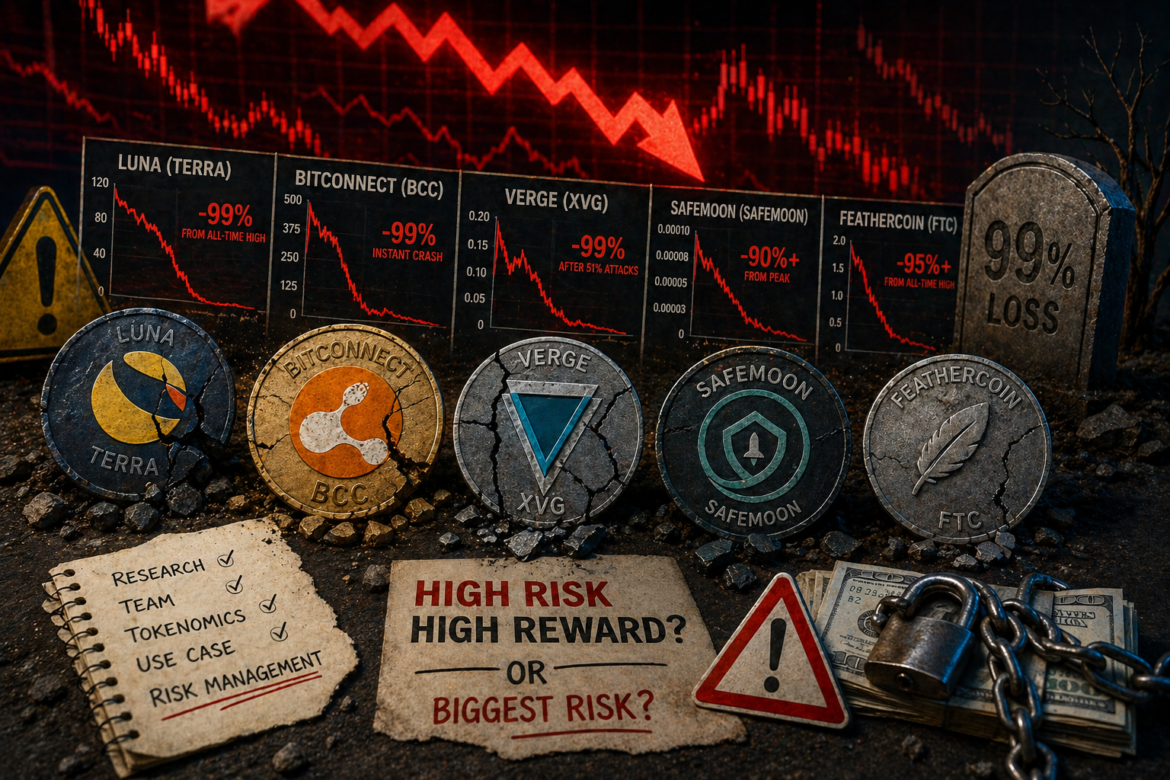
- Within days, LUNA lost over 99% of its value and the project effectively collapsed.
Investors who bought LUNA at its peak lost almost everything. The ecosystem was impressive on the surface, but when the stress hit, the design couldn’t handle it.
Why this matters for you:
LUNA is a textbook example of how a smart‑sounding idea can still lead to extreme downside if the underlying mechanics are fragile and rely too much on confidence. Never assume a peg or a “too good to be true” yield is safe just because it’s branded as “innovative.”
BitConnect (BCC) – Ponzi dressed as crypto
If you’ve read about crypto scams, you’ve probably heard of BitConnect.
What it promised:
BitConnect offered a “lending and trading” program where you lent your money (in the form of BCC tokens) and got a crazy high daily return, often quoted as a percentage that would double or triple your money in a few months. They claimed it was powered by a special trading bot, but there was never any real proof the bot worked.
What went wrong:
- In reality, BitConnect looked a lot like a classic Ponzi scheme: new deposits were used to pay earlier investors, not real profits.
- Regulators started investigating, and in early 2018 the platform shut down its lending program overnight.
- When that happened, the value of BCC crashed by more than 99% almost instantly.
- Today, the token is basically worthless and the project is widely regarded as a scam.
Many people who joined late lost everything, even though early members briefly saw incredible “returns” on paper.
Why this matters for you:
BitConnect is a clear example of how extreme promises almost always come with extreme downside risk. If someone promises you unusually high, guaranteed‑sounding returns, it’s almost always a red flag, not a hidden gem.
Verge (XVG) – privacy coin knocked out by attacks
Verge (XVG) once tried to be a privacy‑focused alternative to Bitcoin.
What it promised:
Verge marketed itself as a fast, private coin that could rival Monero or Zcash. It even got a short‑lived partnership with a major adult‑content site, which pushed its popularity and price higher for a while.
What went wrong:
- Verge suffered multiple 51% attacks in 2018, where attackers temporarily took control of the network and double‑spent coins.
- These attacks shattered trust in the coin’s security.
- The price, which had briefly spiked, fell by more than 99% from its all‑time high and has never meaningfully recovered.
Even though Verge still trades on some exchanges, it spends most of its time near its lowest levels, showing how a single security failure can destroy long‑term value.
Why this matters for you:
Verge illustrates that even coins with a real use case (privacy) can still suffer massive downside if the tech or security is weak. Features and hype don’t matter much if the underlying network can’t defend itself from attacks.
SafeMoon (SAFEMOON) – the hype‑driven reward trap
SafeMoon was one of the poster children of the 2021 meme‑coin boom.
What it promised:
SafeMoon introduced a “reflection” model: every time someone bought or sold the token, a small fee was taken, and a portion of that fee was redistributed to all existing holders. This created the illusion that every trade was “rewarding” long‑term holders, even though the price kept falling.
What went wrong:
- The tokenomics were heavily skewed in favor of early sellers and insiders, who could dump large amounts without triggering the same penalties retail investors faced.
- When the hype faded and big sellers started cashing out, the price dropped sharply.
- Over time, SafeMoon lost the vast majority of its value, dropping roughly 90–99% from its peak depending on the timing.
Retail investors who bought in during the height of the hype often watched their holdings shrink to a tiny fraction of their original value.
Why this matters for you:
SafeMoon shows how clever‑sounding token‑fee designs can hide brutal downside risk. If the structure benefits insiders first and relies on constant new money, it can easily become a one‑way ride down for latecomers.
Feathercoin (FTC) – an early altcoin that faded away
Feathercoin is one of the older altcoins, dating back to 2013.
What it promised:
It was positioned as a faster, lighter alternative to Bitcoin, with quicker block times and a friendlier mining experience for ordinary users. Back then, anything that wasn’t Bitcoin was exciting, so Feathercoin picked up a small but loyal community.
What went wrong:
- As better‑designed and more scalable projects emerged (Ethereum, Litecoin, and later BNB‑chain, Solana, etc.), Feathercoin struggled to keep up.
- It never really found a strong niche or killer use case, and attention moved elsewhere.
- The price has been stuck near its lowest levels for years, effectively down more than 95% from its all‑time highs in the early‑ 2010s.
Feathercoin is still technically alive, but it trades like a “zombie” altcoin—still kicking but with almost no real momentum.
Why this matters for you:
Feathercoin is a reminder that being “first” or “early” doesn’t protect you from downside risk if the project doesn’t evolve or solve real problems. A lot of old altcoins quietly die by erosion, not by one big crash.
Other altcoins that took heavy hits
Beyond the big names, there are many other altcoins that have suffered significant downside risk:
- ETC‑Vision (ETCV): A scam fork that pretended to be a free airdrop from Ethereum Classic. Scammers dumped a pre‑mined supply immediately after launch, causing the price to crash almost instantly and never recover.
- Various “dead coins”: A 2025 CoinGecko‑style analysis estimated that over half of all cryptocurrencies ever created have effectively failed or stopped trading, meaning they’re stuck near zero.
- Many altcoins near all‑time lows: A 2026 market analysis found that nearly 40% of major altcoins trade close to their all‑time lows, showing how much downside risk exists across the broader market.
These aren’t just “bad trades.” They’re examples of how altcoins can get stuck in a long, painful decline, even if they started with decent ideas or teams.
Why altcoins often fall harder than Bitcoin
You might notice that when the market crashes, altcoins usually drop much more than Bitcoin. There are a few reasons for this.
- Less demand floor: Bitcoin has the biggest brand, the longest history, and the most institutional interest. When people panic, they often dump riskier altcoins first and keep, or even buy, Bitcoin.
- Smaller communities: Many altcoins depend on a relatively small group of supporters. If that group loses faith, liquidity dries up fast, and the price can collapse.
- Niche or experimental use cases: If an altcoin’s idea doesn’t work out or gets out‑competed, there’s often nowhere for the price to go but down.
This is why “altcoin season” feels great when prices are rising but can be brutal when they reverse.
What these examples teach everyday investors
Looking at these historical cases, a few clear lessons stand out:
- Extreme promises usually mean extreme risk
If a project promises unusually high returns, magic algorithms, or “guaranteed” stability, treat it as a red flag, not a free‑money ticket. - Design and security really matter
Coins that failed because of technical flaws or attacks (like Verge or Terra) show that even “good ideas” can turn into disasters if the underlying model or code is weak. - Hype fades, but downside can stay
Many altcoins crash because they’re built on pure hype rather than real, lasting value. Once the hype dies, the price often stays down for years. - Diversification doesn’t mean “all‑in on altcoins”
Spreading money across 20 weak projects is not the same as diversification. It’s often just spreading risk across 20 places that can all fall hard at the same time.
How to protect yourself from similar downside risk
If you still want to explore altcoins, you can reduce your chances of landing in one of these horror‑story cases:
- Do the basics first
Understand what the coin actually does, who is behind it, and whether it solves a real problem. Avoid anything that’s mostly about “get‑rich‑quick” talk and vague buzzwords. - Check the team and track record
Look for projects with real developers, audited code, and a clear roadmap—not anonymous “gurus” promising secret, guaranteed strategies. - Watch the tokenomics
Ask: Who owns the tokens? How are they distributed? Are there big early‑holder dumps waiting to happen? Projects that are too skewed in favor of insiders are riskier. - Limit your position size
Even if an altcoin looks promising, treat it as a small, speculative part of your portfolio. That way, if it takes a 90% haircut, your overall finances won’t be wrecked. - Have an exit plan
Decide in advance what you’ll do if the price drops 50%, 70%, or 90%. Knee‑jerk reactions rarely help; a clear plan keeps you from holding onto a dead asset for emotional reasons.
Final takeaway
Yes, there are plenty of historical examples of altcoins that experienced significant downside risk—Terra, BitConnect, Verge, SafeMoon, Feathercoin, and many lesser‑known “dead coins” all show how quickly value can disappear.
The good news is that you don’t have to become a victim of those patterns. By focusing on real projects, understanding the risks, and keeping your altcoin exposure reasonable, you can still explore the space without gambling your whole portfolio.
If your only goal is to learn whether altcoins can go down hard, the answer is clear: they absolutely can—and in some cases, they’ve crashed so badly that “recovering” isn’t even on the table anymore.